Anglesey, United Kingdom: A Royal Air Force (RAF) BAE Systems Hawk T2 advanced jet trainer crashed shortly after take-off from RAF Valley in Anglesey, North Wales, on 23 September 2026 after both pilots ejected from the aircraft. The two crew members were taken to hospital with injuries believed to be minor, while no injuries on the ground or wider damage were reported. The cause of the crash remains under investigation.
The aircraft was operating a training flight from RAF Valley, home to the RAF’s No. 4 Flying Training School, which trains RAF and Royal Navy fast-jet pilots. The Hawk T2, also known as the Hawk 128, is a two-seat, transonic advanced training aircraft manufactured by BAE Systems and operated by the Royal Air Force. The RAF describes it as a high-performance trainer equipped with advanced avionics and synthetic radar designed to simulate frontline combat aircraft such as the Eurofighter Typhoon.
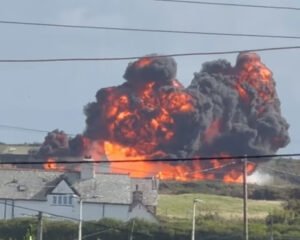
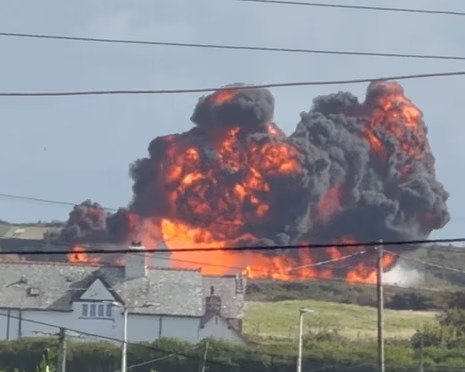
The crash occurred in the Pencarnisiog area of Anglesey, less than two miles from RAF Valley. Video footage and photographs from the scene showed the aircraft climbing shortly after departure before appearing to lose control and descend rapidly. Both pilots ejected before the aircraft struck the ground and erupted into a large fireball. The wreckage came down near houses, agricultural buildings and a caravan area, but authorities reported no wider injuries.
Witness footage and accounts indicate that the aircraft encountered difficulties almost immediately after take-off. Local resident Pete Bennett, who watched the aircraft depart, said that he saw an orange flame as the aircraft accelerated.
“I knew straight away that it was in trouble. Right on takeoff there was an orange flame, and as it accelerated it was basically on fire,” Bennett said. He added that the flame appeared to disappear as the aircraft gained altitude but that the aircraft continued to look distressed.
According to the witness, the aircraft then climbed at an aggressive pitch before pitching violently twice. He said there were two loud bangs at about 800 feet, after which both pilots ejected and their parachutes opened. The aircraft subsequently rolled and descended towards the ground, where it crashed and produced a large fire and black smoke.
These observations do not establish the technical cause of the accident. Neither the RAF nor the Ministry of Defence has attributed the crash to an engine failure, fire, flight-control problem or any other specific malfunction. The investigation is continuing.
There were two people aboard the aircraft both pilots and both ejected before impact. They were located after the ejection and taken for medical treatment. The RAF later confirmed that both pilots were receiving medical treatment and that their families were being supported.
The survival of the crew was aided by the Hawk’s ejection system. BBC security analyst and former RAF officer Mikey Kay said the ejection seats are designed to allow pilots to escape even at very low speed and altitude, although the exact circumstances of the ejections will form part of the investigation.
An RAF spokesperson said, “An incident involving an RAF T2 Hawk aircraft, flying out of RAF Valley, occurred near Anglesey. An investigation is under way and we will not comment further at this time.”
The RAF subsequently announced that Hawk operations had been temporarily suspended. Its statement said, “Following an incident involving an RAF Hawk T2 aircraft today, both pilots are receiving medical treatment. Their families are being supported.”
The RAF added, “The RAF has decided to temporarily pause Hawk T1 and T2 operations, as a precautionary measure, whilst investigations are ongoing.”
Defence Secretary Wes Streeting, speaking at the UK Space Power Conference on the day of the accident, said, “A T2 Hawk aircraft went down shortly after take-off, both crew members ejected as you may have seen. I’m glad to say they’ve now been taken to hospital for treatment.”
He added, “We’re investigating how and why this happened. But for now, our best wishes go to the crew along with our hopes for a speedy recovery.”
Streeting also said in a post on X, “My thoughts are first and foremost with the pilots.” He added that further updates would be provided in due course.
North Wales Police said, “Two pilots are being treated for what are thought to be minor injuries and at this stage there are no reports of any wider damage or injuries.”
The force asked members of the public to avoid the crash area while emergency services dealt with the incident. North Wales Fire and Rescue Service said, “Crews and officers attended an incident involving an aircraft in the Pencarnisiog area of Anglesey, working alongside colleagues from Royal Air Force, North Wales Police, Welsh ambulance service and Wales Air Ambulance.”
The service later confirmed, “The fire is now under control.” It also asked the public to avoid the area while emergency crews continued their work.
RAF responders, police, fire and rescue crews, the Welsh Ambulance Service, Wales Air Ambulance and Coastguard assets were involved in the response.
The investigation is now focused on determining how and why the aircraft went down shortly after take-off. At present, authorities have not publicly identified the initiating failure or confirmed whether the fire/flames observed by the witness were a cause of the accident or occurred as a consequence of an underlying problem. No fatalities have been reported. Both pilots survived after ejecting, and no members of the public were reported injured. The investigation remains ongoing.