Miami, United States: One of the pilots of Amazon Prime Air Flight 7598 repeatedly warned that the Boeing 767 was travelling too fast during its final approach to Miami International Airport, according to newly released cockpit recorder information from the US National Transportation Safety Board (NTSB).
The NTSB said that about one minute and 42 seconds before the cockpit voice recorder ended, one pilot called for the flaps to be set to 20 degrees while the other cautioned that the aircraft was “too fast.” The pilot continued making comments about the aircraft’s excessive speed throughout the remainder of the recording, but investigators said there was no consistent verbal response to those concerns.
The newly released preliminary evidence provides the clearest account yet of the final moments before the cargo aircraft overran Runway 30 on September 6, 2026, struck vehicles beyond the airport and killed five people on the ground.
The Boeing 767-33A, operated by 21 Air as Amazon Prime Air Flight 7598, had arrived from San Juan, Puerto Rico, on its third flight of the day. Only the two pilots were onboard the aircraft.
The NTSB recovered both the cockpit voice recorder and flight data recorder and successfully read them at its laboratory in Washington. The cockpit recorder contained more than two hours of good-quality audio across four channels, while the flight recorder contained about 54 hours of information covering more than 400 parameters.
According to the preliminary timeline, the crew was cleared to land on Runway 30 about four minutes before the recording ended. The landing gear was lowered, and the crew progressively selected additional flap settings.
About 1 minute and 23 seconds before the end of the recording, sounds consistent with the autopilot disconnect were captured.
The aircraft then descended amid a series of automated warnings. The cockpit recorded two “sink rate” warnings, followed by the electronic 500-foot, 100-foot and minimums callouts. About 48 seconds before the recording ended, the automated “too low terrain” warning sounded four times, followed by another such warning seconds later.
Sounds consistent with touchdown were recorded about 31 seconds before the end of the cockpit recording.
Flight data showed the aircraft’s nose and right main landing gear touched down at a groundspeed of 158 knots. The brakes were applied as the aircraft slowed to 146 knots, while the left main gear touched down at 134 knots.
About 15 seconds before the end of the recording, a pilot called for a go-around. At the same time, the brakes were released at a groundspeed of 120 knots and the throttles were increased to a setting consistent with go-around thrust.
However, four seconds later, the throttles were reduced to idle and the brakes were reapplied while the aircraft was still travelling at 117 knots.
About seven seconds before the flight recorder ended, the recorded acceleration values changed markedly. The aircraft subsequently left the paved surface, according to the preliminary data.
The NTSB said the final recorded groundspeed was 65 knots and found no indication in the recorded data that either the speed brakes or thrust reversers were deployed.
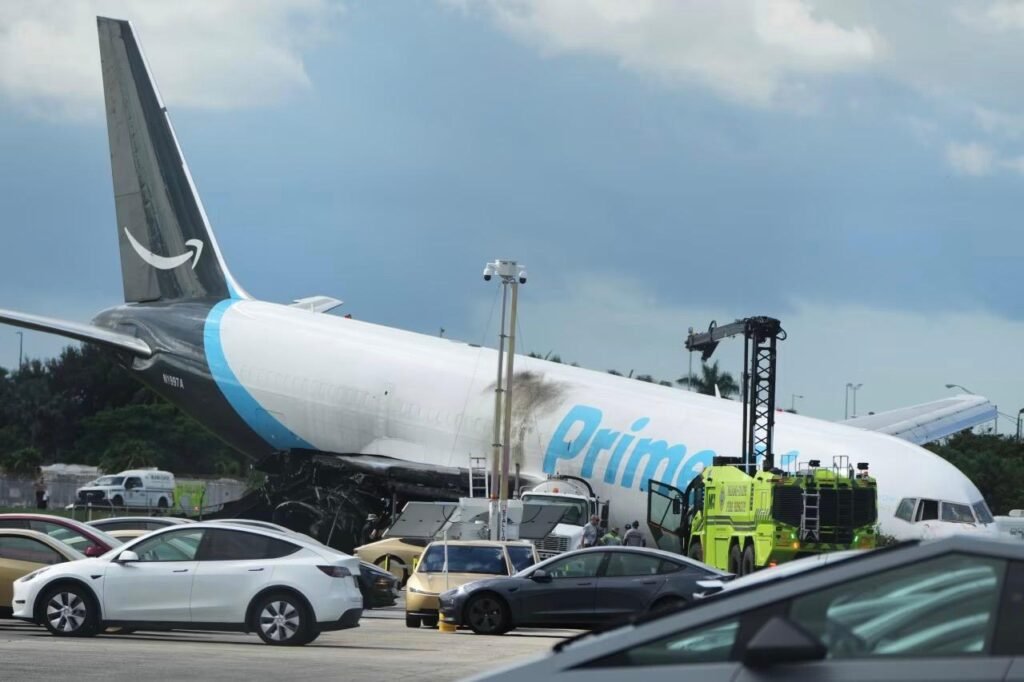
The aircraft travelled about 1,300 feet beyond the runway, struck a van carrying airport cleaning workers, continued through the airport perimeter area and later struck a Toyota Corolla Cross before catching fire.
The NTSB stressed that all recorder information released so far is preliminary and subject to change. It has not yet determined the probable cause of the accident.
The confirmed death toll remains five, according to the latest available information from Miami-Dade authorities. All five people killed were occupants of the van struck by the Boeing 767.
The victims were identified as, Rolando Aleman Leon, 55; Yoel Rodriguez Naranjo, 53; Julio C. Pineda, 75; Carlos Acosta Fajardo, 53 and Javierkys Reyes Quevedo, 47.
They were employees of Professional Ocean Service Corp., an aircraft-cleaning contractor at Miami International Airport. Reports said the workers were finishing their shift when the crash occurred.
Five other people were injured in the accident. The two pilots survived and were released from hospital. The latest local authority updates reported that two other injured people remained in critical condition, while another was in stable condition.
NTSB investigators have interviewed the captain and first officer and will conduct a detailed review of the cockpit recording before producing a written transcript.
The investigation is continuing into the circumstances surrounding the approach and landing, including the aircraft’s speed, the automated cockpit warnings, the attempted go-around and why the speed brakes and thrust reversers were not indicated as deployed in the recorded data.
Investigators are also examining the broader circumstances surrounding the runway excursion, including weather and runway safety factors. The NTSB has previously said it will review whether the absence of an Engineered Materials Arresting System (EMAS) at the runway end was relevant, although Miami International Airport met applicable FAA runway safety requirements.
The final NTSB report, which will determine the probable cause and issue any safety recommendations, is expected to take considerably longer. For now, the investigation remains ongoing.