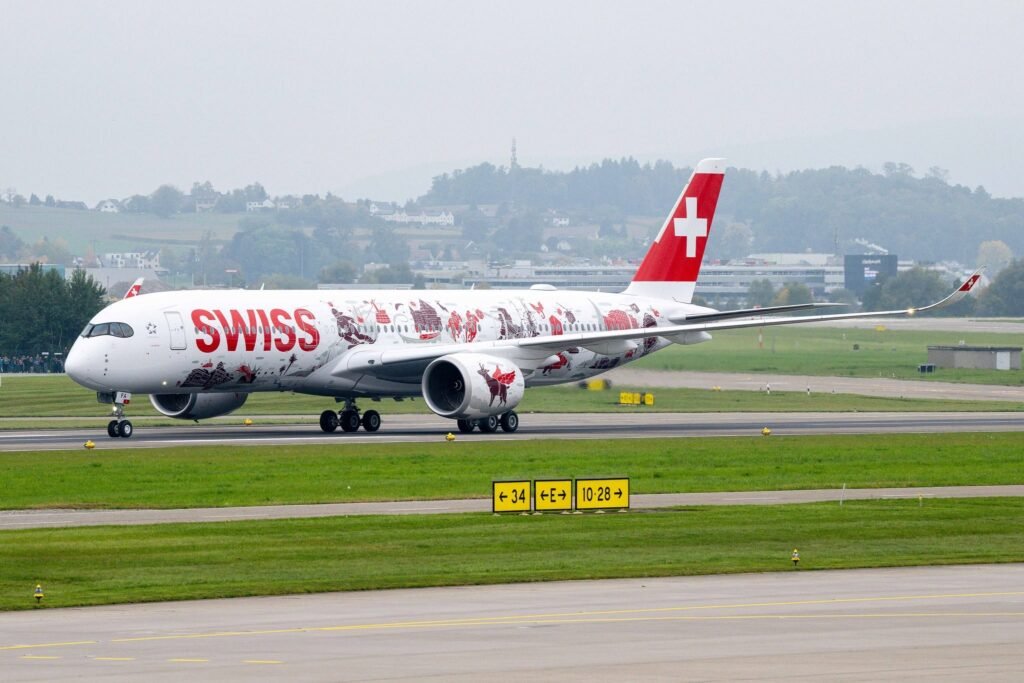
Dublin, Ireland: A SWISS Airbus A330-300 operating flight LX52 from Zurich to Boston was diverted to Dublin after smoke was reported on board while the aircraft was flying over the Atlantic on August 9, 2026. The aircraft, carrying 206 passengers, landed safely at Dublin Airport in the early hours of August 10 after the crew declared an emergency and requested priority landing clearance.
Flight LX52 departed Zurich Airport at around 6:11 p.m. local time on Sunday, according to SWI swissinfo, and was scheduled to continue across the Atlantic to Boston Logan International Airport. SWISS’s published schedule identifies LX52 as the Zurich-Boston service, with the route normally operated as a non-stop flight of about 8 hours and 20 minutes.
While the aircraft was en route over the Atlantic, smoke was detected on board. SWISS told the Swiss News Agency Keystone-ATS that the smoke was caused by a power bank. The airline said the cockpit crew immediately requested authorization for a priority landing after the situation was identified.
A SWISS spokesperson said, “The cockpit crew of flight LX52 from Zurich to Boston diverted to Dublin Airport in Ireland.” The airline added: “The reason was smoke on board, which was caused by a power bank.”
FlightAware data reported that the aircraft had spent nearly five hours in the air before landing in Dublin. All 206 passengers were accommodated in a hotel overnight while SWISS worked on onward travel arrangements.
SWISS said the aircraft would undergo a thorough inspection before being transferred back to Zurich. No injuries were reported in the available accounts, and there was no indication of damage to the aircraft beyond the smoke-producing battery incident.
The incident has also renewed attention on SWISS’s restrictions concerning portable power banks. The airline introduced stricter rules from January 15, 2026, under which passengers may carry a maximum of two power banks, while charging or using them to charge other devices during flight is prohibited, except for essential medical devices. Power banks must remain accessible and may not be placed in overhead baggage compartments or checked baggage.
SWISS said the rules were introduced because lithium-battery power banks can present a potential fire risk if they malfunction. The airline’s current guidance allows power banks of up to 100 watt-hours without prior approval, while units above 100 Wh and up to 160 Wh require airline approval.
The LX52 diversion was the second recent SWISS flight incident involving smoke associated with a battery-powered passenger device. On July 27, SWISS flight LX16 from Zurich to New York was diverted to Bangor International Airport in Maine after smoke was reported in the cabin. SWISS later determined that a headphone charging case had slipped into a seat and become jammed, damaging the device and causing it to heat up and produce smoke.
The latest incident therefore involved a different device and route, but again resulted in an unscheduled diversion after smoke was detected in flight. SWISS has not indicated that the aircraft suffered a mechanical failure, with the airline specifically attributing the LX52 smoke to a power bank.