News
Civil Aviation
Pilot Training
Flight School Analysis
Aviation Jobs
Training
Services
About Us
Contact Us

Loganair Orders 5 Electric Aircraft To Become Europe’s First Commercial Electric Airline

Picture of Aviation Today News Desk

Aviation Today News Desk

Farnborough, United Kingdom: Loganair has signed a term sheet with BETA Technologies to add five all-electric ALIA conventional takeoff and landing (CTOL) aircraft, also known as the CX300, to its fleet, with an option for five additional aircraft. The announcement was made on July 20, 2026, at the Farnborough International Airshow. The agreement could make Loganair Europe's first commercial airline to operate an electric aircraft fleet, with the first aircraft expected to enter service in 2029. The move follows a UK-first electric flight demonstration programme completed in March 2026. During the programme, BETA's CTOL aircraft completed 23 flights over 10 days across Loganair's network, connecting Glasgow, Dundee, Aberdeen, Inverness, Wick and Kirkwall. The demonstration flights covered more than 1,000 nautical miles in real-world operating conditions and served some of Scotland's most remote communities. The programme was designed to validate the aircraft's performance, ground handling, charging capabilities and integration with existing airport and airspace systems. Loganair said Scotland and the wider UK provide a natural environment for commercial electric aviation, particularly because island and remote communities depend heavily on short-distance air services. Most of the airline's regional sectors are under 100 miles, aligning with the CX300's intended mission profile. The aircraft can operate from existing runways and can be recharged in 20 to 40 minutes using BETA's fast-charging systems. Once introduced, the aircraft are expected to support both passenger and cargo operations across Loganair's network. According to the airline, the electric aircraft could provide greater operational flexibility, lower operating costs and zero in-flight emissions. Loganair also said the technology has the potential to reduce operating costs by up to 80% while maintaining the regional connectivity relied upon by communities across the country. The agreement includes plans for technical support and integration to help introduce the aircraft into Loganair's existing fleet. The airline said it will continue exploring how electric aviation can support resilient, efficient and lower-emission regional air services. Loganair CEO Luke Farajallah described the agreement as a historic moment for the airline and European aviation. He said the earlier demonstration programme showed that electric aviation had moved beyond being a future concept and could represent a viable commercial opportunity within Loganair's existing network. BETA Technologies founder and CEO Kyle Clark said Loganair's six decades of connecting communities that depend on air travel meant the airline had a high standard for adopting new technology. He said BETA had demonstrated the aircraft's capabilities by flying more than 1,000 nautical miles across Loganair's network, on its routes and under its operating conditions. The planned addition of the ALIA CTOL aircraft marks the next stage of the Loganair-BETA partnership, moving from flight demonstrations toward potential commercial fleet deployment in 2029.

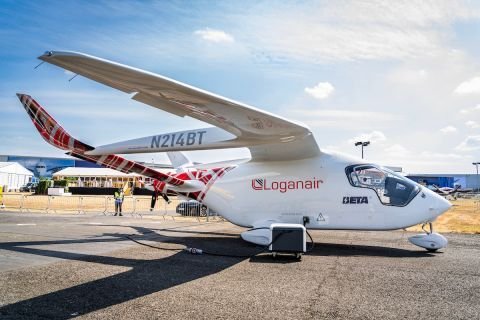
Image: Loganair

Farnborough, United Kingdom: Loganair has signed a term sheet with BETA Technologies to add five all-electric ALIA conventional takeoff and landing (CTOL) aircraft, also known as the CX300, to its fleet, with an option for five additional aircraft. The announcement was made on July 20, 2026, at the Farnborough International Airshow.

The agreement could make Loganair Europe’s first commercial airline to operate an electric aircraft fleet, with the first aircraft expected to enter service in 2029.

The move follows a UK-first electric flight demonstration programme completed in March 2026. During the programme, BETA’s CTOL aircraft completed 23 flights over 10 days across Loganair’s network, connecting Glasgow, Dundee, Aberdeen, Inverness, Wick and Kirkwall.

The demonstration flights covered more than 1,000 nautical miles in real-world operating conditions and served some of Scotland’s most remote communities. The programme was designed to validate the aircraft’s performance, ground handling, charging capabilities and integration with existing airport and airspace systems.

Loganair said Scotland and the wider UK provide a natural environment for commercial electric aviation, particularly because island and remote communities depend heavily on short-distance air services. Most of the airline’s regional sectors are under 100 miles, aligning with the CX300’s intended mission profile.

The aircraft can operate from existing runways and can be recharged in 20 to 40 minutes using BETA’s fast-charging systems. Once introduced, the aircraft are expected to support both passenger and cargo operations across Loganair’s network.

According to the airline, the electric aircraft could provide greater operational flexibility, lower operating costs and zero in-flight emissions. Loganair also said the technology has the potential to reduce operating costs by up to 80% while maintaining the regional connectivity relied upon by communities across the country.

The agreement includes plans for technical support and integration to help introduce the aircraft into Loganair’s existing fleet. The airline said it will continue exploring how electric aviation can support resilient, efficient and lower-emission regional air services.

Loganair CEO Luke Farajallah described the agreement as a historic moment for the airline and European aviation. He said the earlier demonstration programme showed that electric aviation had moved beyond being a future concept and could represent a viable commercial opportunity within Loganair’s existing network.

BETA Technologies founder and CEO Kyle Clark said Loganair’s six decades of connecting communities that depend on air travel meant the airline had a high standard for adopting new technology. He said BETA had demonstrated the aircraft’s capabilities by flying more than 1,000 nautical miles across Loganair’s network, on its routes and under its operating conditions.

The planned addition of the ALIA CTOL aircraft marks the next stage of the Loganair-BETA partnership, moving from flight demonstrations toward potential commercial fleet deployment in 2029.


Leave a Comment

Subscribe to our Newsletter

Recent News

Aviation Today Perspectives