Demand Must Lead Infrastructure Decisions
The most important strategic principle for AAM is simple: build where demand is painful, valuable, repeatable, and time-sensitive. Too many early AAM strategies begin with supply-side questions. Where is the land available? Where can a rooftop be converted? Which airport has spare capacity? Which local government is willing to announce a pilot? These questions matter, but they are not enough.
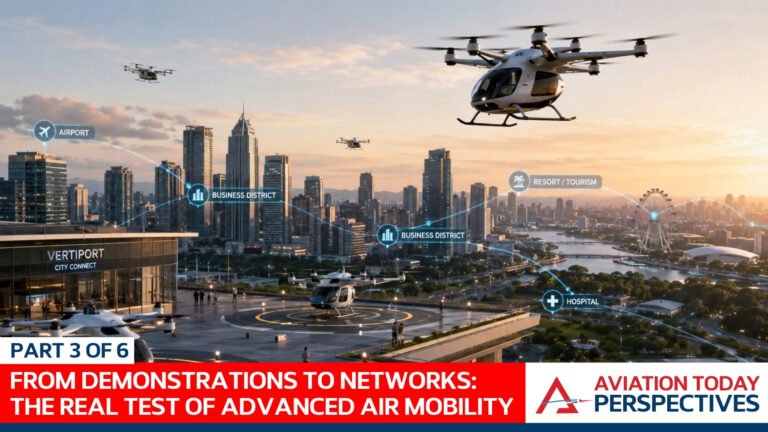
A convenient vertiport without a compelling passenger market is simply an expensive landing pad. Instead, governments and operators should begin with the passenger journey. They should ask where travel times are unreliable, where road congestion imposes substantial economic costs, where airport access creates friction, where existing transit requires multiple transfers, where major business districts are poorly connected, and where premium travelers value reliability more than the lowest possible fare.
The target market may include airport passengers, business travelers, convention attendees, medical travelers, high-value tourists, executives, families traveling under time pressure, and travelers moving between dispersed metropolitan hubs. The Lufthansa Innovation Hub AAM Route Attractiveness Report, which analyzes 42 global cities to identify the most commercially viable launch points for AAM, offers the right strategic lens.
It emphasizes that AAM attractiveness is a combination of feasibility and viability. Feasibility includes terrain, airspace, and government readiness. Viability includes weather, local-area characteristics, and, most importantly, time savings over ground transportation. In the report’s methodology, time savings receives the greatest weight on the viability side, while authority readiness receives the greatest weight on the feasibility side. That is a useful corrective for the industry. AAM is not valuable simply because it is faster in the air. It is valuable when it provides a meaningful, dependable, door-to-door advantage over the available alternatives.
A ten-minute flight that requires a forty-minute trip to the vertiport, a lengthy security process, uncertain boarding, and a complicated onward journey is not a transportation revolution. It is an aviation novelty. AAM must eliminate friction at both ends of the flight, not merely reduce the time in the middle. Latent demand is different from market adoption; adoption occurs only when the full journey is reliable, intuitive, and worth repeating.
The Most Viable Near-Term Model Is Premium Transportation on Demand
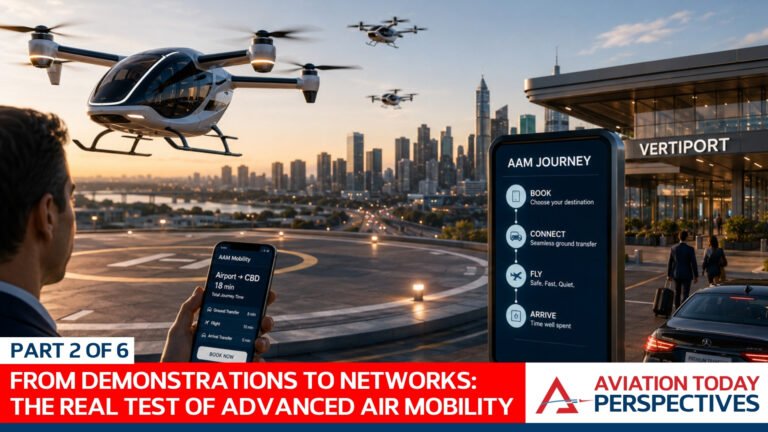
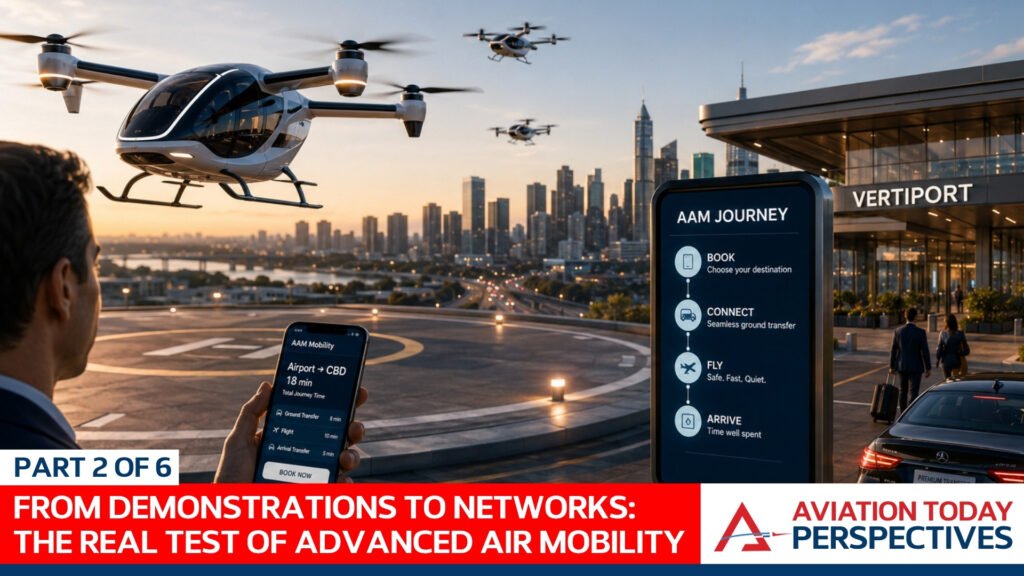
The most realistic near-term model for AAM is not mass transit in the traditional sense. It is a high-end, digitally integrated transportation-on-demand service: the aerial equivalent of a premium Uber product. Passengers should be able to open an app, compare travel options, see total journey time, reserve a seat or aircraft, receive accurate pricing, connect to ground transportation, and arrive at their destination with minimal friction. The service should feel less like chartering an aircraft and more like booking a premium, dependable mobility option. This model recognizes a practical reality. Early eVTOL operations will likely have limited fleet capacity, constrained vertiport availability, high capital costs, and a need to establish reliable operating patterns.
At launch, AAM will not serve every traveler. It should instead serve passengers for whom time reliability and convenience justify a premium fare. That is not a weakness. It is a disciplined market-entry strategy. Premium transportation services often create the operational base necessary for broader adoption.
Early customers help establish route frequency, operational data, public familiarity, and revenue stability. Over time, higher vehicle utilization, improved infrastructure, larger fleets, more efficient maintenance, and broader market competition can reduce per-passenger costs. The goal is not to pretend that early AAM service will be inexpensive. The goal is to create a credible path from premium mobility to a more accessible transportation layer.
The premium Uber model also reinforces the need for true intermodal integration. A passenger should not have to solve a separate mobility problem before and after the flight. The air leg should be embedded within a complete trip, potentially including premium ground transportation, rail connections, airport processing, hotel access, event access, and destinationside mobility.
AAM should be sold as time certainty, not merely flight time. That commercial discipline matters because early AAM economics will be unforgiving. Aircraft utilization, vertiport throughput, maintenance cycles, charging or fueling turnaround, staffing, insurance, and passenger load factors will determine whether a route becomes a scalable service or remains a subsidized demonstration. Premium pricing, in that sense, is not simply a branding choice. It is the most realistic way to absorb high early operating costs while building the frequency, reliability, and customer familiarity that broader adoption will require.
This is the 2nd of a series of 6 articles on: “From Demonstrations to Networks: The Real Test of Advanced Air Mobility”
Read Part 1 of this six-part series here
This article is part of Aviation Today’s Perspectives, a dedicated series that publishes expert viewpoints from aviation authorities and industry leaders on emerging trends, policy developments, and the future of global aviation.
Disclaimer: The views and opinions expressed in this article are solely those of the authors and do not necessarily reflect the views or editorial position of Aviation Today.
About The Authors