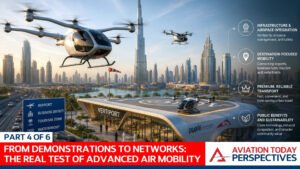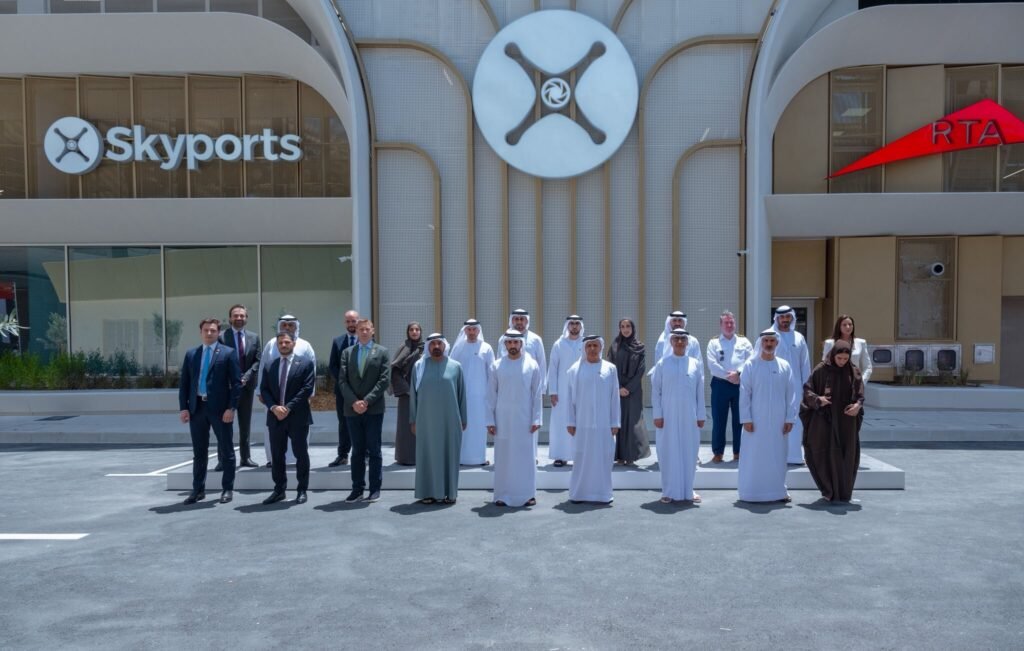
Dubai, United Arab Emirates: Dubai has taken a significant step toward launching commercial electric air taxi services after the United Arab Emirates’ General Civil Aviation Authority (GCAA) certified the world’s first purpose-built commercial vertiport for electric vertical take-off and landing (eVTOL) aircraft operations.
The certification of VDX, developed by Skyports Infrastructure in partnership with Dubai’s Roads and Transport Authority (RTA), establishes the regulatory foundation for commercial air taxi operations in the emirate and positions the UAE as the first country to certify a dedicated commercial vertiport for passenger eVTOL services. The approval is being regarded as a landmark achievement for advanced air mobility (AAM), demonstrating that the infrastructure and regulatory framework required for safe commercial electric air taxi operations are now in place.
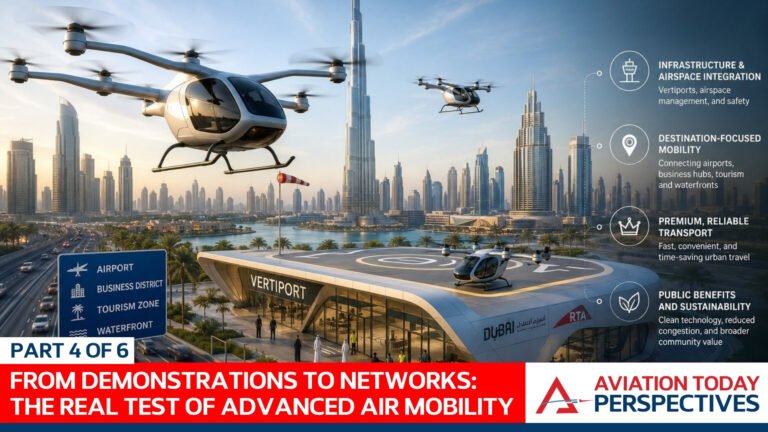
Located adjacent to Dubai International Airport (DXB), VDX will serve as the flagship hub of Dubai’s planned air taxi network. Three additional vertiports are currently under development at Downtown Dubai, Dubai Marina and Palm Jumeirah, creating what is expected to become the world’s first integrated commercial air taxi network. Commercial operations remain on track to begin before the end of 2026, subject to final aircraft certification and operational approvals.
The newly certified four-storey vertiport spans approximately 3,100 square metres and has been purpose-built to support high-frequency passenger operations. The facility features two dedicated eVTOL take-off and landing pads, rapid charging infrastructure for electric aircraft, passenger processing facilities, security screening areas and operational support infrastructure designed to integrate seamlessly with Dubai’s wider transportation network. Once fully operational, VDX is expected to accommodate up to 170,000 passengers annually, reinforcing Dubai’s strategy of integrating advanced air mobility into its existing public transport ecosystem.

According to the GCAA, the certification confirms that both the physical infrastructure and operational framework meet the authority’s safety and regulatory requirements for commercial eVTOL operations. Officials described the approval as a defining moment for the future of aviation, noting that the UAE is establishing international benchmarks for advanced air mobility rather than simply preparing for emerging technologies.
Saif Mohammed Al Suwaidi, Director General of the GCAA, described the certification as “a historic achievement for the UAE and a defining moment for the future of aviation.”
“The UAE is not only preparing for the future of aviation; it is actively shaping it and establishing new international benchmarks for Advanced Air Mobility,” Al Suwaidi said, adding that the approval demonstrates the country’s commitment to enabling safe, sustainable and commercially viable next-generation aviation.
Skyports Infrastructure said the certification represents one of the final infrastructure milestones before passenger services can begin.
Duncan Walker, Chief Executive Officer of Skyports Infrastructure, said, “With VDX now certified and construction of the wider Dubai Air Taxi Network progressing at pace, we are one step closer to launching commercial air taxi operations, and unlocking a new era of safe, efficient and sustainable urban transport.”
Walker added that achieving certification validates years of collaboration between Skyports, the GCAA, the RTA and industry partners to create one of the world’s first fully regulated commercial eVTOL ecosystems.
The air taxi network will initially be operated using Joby Aviation’s all-electric aircraft, which is designed to carry a pilot and four passengers. The aircraft has a maximum speed of approximately 320 km/h (200 mph) and a range of about 160 km (100 miles) while producing zero operational emissions and substantially lower noise levels than conventional helicopters. The network is expected to reduce travel times dramatically, with journeys between Dubai International Airport and Palm Jumeirah projected to take around 10 minutes, compared with approximately 45 minutes by road, depending on traffic conditions.
The certification also reflects Dubai’s broader ambition to become a global leader in urban air mobility. The emirate has spent several years developing the regulatory framework, infrastructure, aircraft partnerships and operational ecosystem required to support commercial eVTOL services. Previous milestones have included approval of the vertiport design, commencement of construction and successful flight demonstrations of electric air taxis as the city works toward launching one of the world’s first commercial passenger eVTOL networks.
With the certification now secured, attention shifts to completing the remaining vertiports, final aircraft certification and operational readiness ahead of the planned commercial launch in 2026. Industry observers view the approval as one of the most significant infrastructure milestones achieved globally in the transition from eVTOL flight testing to routine commercial passenger operations, reinforcing Dubai’s ambition to pioneer the next generation of sustainable urban aviation.