Houston, United States: The National Transportation Safety Board (NTSB) has determined the probable cause of the fatal Robinson R44 II helicopter crash in Houston, Texas, in 2024 that killed the pilot and three passengers onboard, was the pilot’s failure to maintain clearance from a lighted radio tower during a night flight. The NTSB published its final report on 23 September 2026.
The NTSB also identified the air traffic controller’s failure to issue a safety alert about the helicopter’s unsafe proximity to the tower as a contributing factor. The investigation found that the tower was marked as an obstruction on Houston VFR sectional and terminal area charts and was also displayed on the controller’s radar. Despite this, no warning was issued to the pilot.
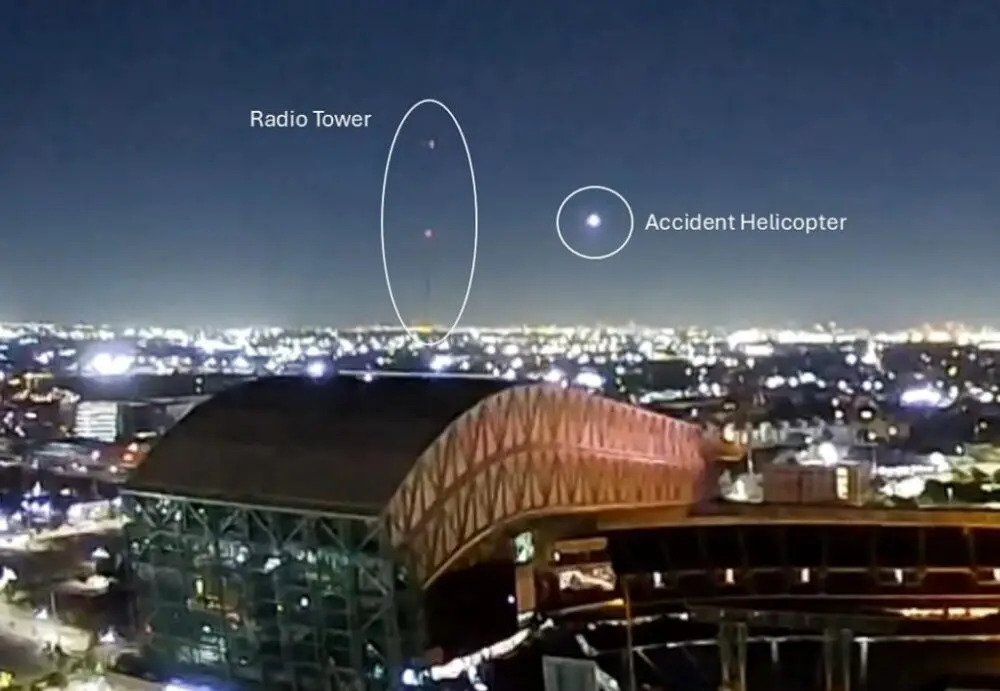
According to the final findings, the helicopter was flying directly toward the tower at an altitude below the tower’s height. Radar replay covering approximately the final 30 seconds showed the tower aligned with the helicopter’s flight path. Surveillance video showed the tower’s top and middle red obstruction lights flashing as the helicopter approached, while the lower beacon was not visible in available imagery.
The NTSB found no mechanical malfunction or failure that would have prevented the helicopter from operating normally. The weather was also not identified as a limiting factor, with clear skies and visibility of about 10 miles at the time of the crash.
The NTSB found that the controller was required to issue a safety alert when aware that an aircraft was in unsafe proximity to an obstruction. Although VFR pilots remain responsible for avoiding obstacles, the investigation determined that the controller’s alert obligation still applied in this case.
Traffic was light at the time and the controller’s workload was described as routine, with no unusual distractions identified.
The accident involved a Robinson R44 II, registration N881KE, operated by National Helicopter Solutions LLC on a night sightseeing flight under 14 CFR Part 91. The helicopter departed Ellington Airport in Houston at about 7:42 p.m. on 20 October 2024, heading toward downtown Houston.
The pilot contacted the Houston Hobby Airport control tower and requested the “downtown loop,” an unpublished route used by local helicopters flying over downtown. The controller approved the request.
Several minutes later, the controller advised the pilot about another company tour helicopter operating nearby. The accident pilot reported that she could see the other helicopter on her ADS-B but had not visually identified it. The controller instructed her to maintain visual separation.
The pilot was reading back that instruction when her radio transmission abruptly ended. No further communication was received from the helicopter.
At approximately 7:51 p.m. on 20 October 2024, the R44 struck a 1,003-foot radio tower about 100 feet below its top. The impact caused an explosion and the helicopter fell to the ground. The tower subsequently collapsed onto the wreckage, and a post-impact fire destroyed the helicopter.
The crash killed the 42-year-old pilot and three passengers onboard.
The pilot held commercial pilot and flight instructor certificates and had accumulated about 1,075 flight hours. She was hired by National Helicopter Solutions in August 2024 and began flying the company helicopter on 23 September 2024, less than a month before the accident.
Investigators were also told by the pilot’s husband that she had worked approximately nine consecutive days before the accident. Toxicology testing, however, found no drugs or alcohol.
The investigation also examined the tower’s obstruction lighting. The tower was equipped with flashing beacons at different heights, and surveillance footage showed the upper two lights flashing as the helicopter approached. The lower beacon could not be seen in the available imagery.
The tower had also been the subject of a NOTAM issued by the FAA before the crash stating that its obstruction lighting was out of service. Initial reporting raised questions about the tower lights, but the tower owner subsequently told investigators that the NOTAM was related to a recent change in ownership and that there were no known outages affecting the flashing beacons.
The NTSB’s preliminary investigation, released after the crash, recorded that the helicopter had departed Ellington Airport at about 7:42 p.m., flew north and then northwest at approximately 900 feet mean sea level, and established communication with the local controller before requesting the downtown loop. The preliminary report also confirmed that the controller issued the traffic advisory shortly before the collision.
At the time of the accident, the NTSB said the helicopter was operating as an air tour flight. The agency’s initial investigation examined the pilot, aircraft and operating environment, including flight-track data, ATC communications, maintenance records, weather and lighting conditions, pilot qualifications and experience, witness statements and available surveillance footage.
The 23 September 2026 final report now concludes the investigation by identifying the pilot’s failure to maintain clearance from the lighted tower as the probable cause and the controller’s failure to issue a required safety alert as a contributing factor.