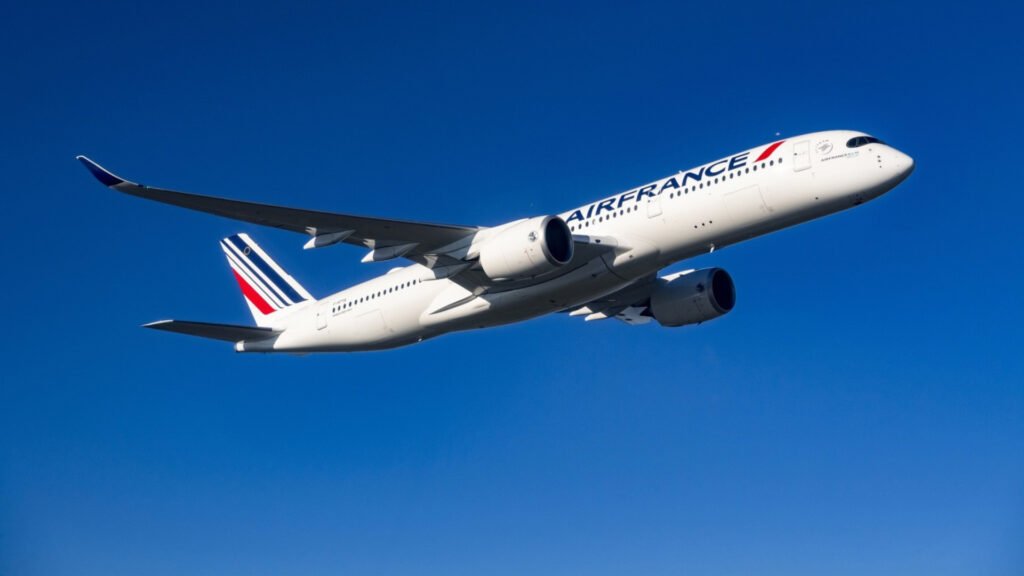
Los Angeles, United States: The Federal Aviation Administration (FAA) is investigating a near midair collision involving an Air France aircraft and an American Airlines flight shortly after departure from Los Angeles International Airport (LAX) on 7 November 2026.
The incident occurred at approximately 12:20 a.m. local time when Air France Flight AF28 made an unauthorized turn after departing from LAX, placing the aircraft in the flight path of another aircraft departing from a parallel runway, according to the FAA’s account of the incident.
Air traffic controllers intervened and issued immediate instructions to the Air France aircraft to correct its flight path. The American Airlines flight was also given instructions to maintain separation from the approaching aircraft.
Recorded air traffic control communications provide further insight into the sequence of events.
During the exchange, the controller instructed Air France Flight 028 to fly a heading of 270 degrees immediately. The crew acknowledged the instruction.
The controller subsequently issued a traffic alert to American Airlines Flight 1660, warning the crew of traffic at its 12 o’clock position, less than one mile away. The American Airlines aircraft was instructed to maintain an altitude of 2,000 feet.
The crew acknowledged the instruction and confirmed that it would return to the assigned altitude.
Following the immediate intervention, the controller questioned the Air France crew about its departure instructions, pointing out that the aircraft had been cleared to climb via its assigned Standard Instrument Departure (SID) rather than turn onto a separate heading.
The controller also asked the crew why it had made the turn and requested confirmation of the departure procedure assigned by the control tower.
The Air France crew subsequently confirmed that it had been instructed to fly the SUMMR2 departure procedure.
During the subsequent exchange, the air traffic controller informed the Air France crew that the incident would be treated as a possible pilot deviation and provided a telephone number for further communication.
The controller later apologised to the American Airlines crew, explaining that the other aircraft had turned in front of them. The American Airlines crew acknowledged the controller’s intervention.
A possible pilot deviation indicates that an aircraft may not have followed an air traffic control instruction or an assigned clearance. However, the terminology used during the radio exchange does not, by itself, establish the cause of the event or determine responsibility.
The FAA’s investigation is expected to examine the circumstances surrounding the aircraft’s departure and the actions that led to the loss of normal separation between the two flights.
Both aircraft continued their respective journeys following the air traffic control intervention.