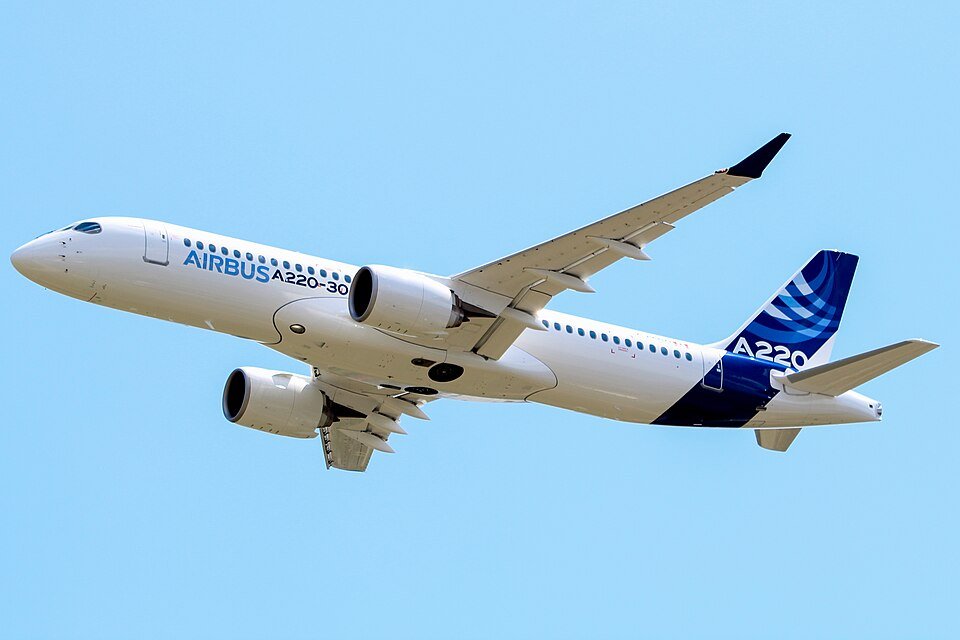
Mirabel, Canada: Airbus Canada and Pratt & Whitney have declared that the technical issues that disrupted the Airbus A220 programme for several years are nearing resolution, with both companies expecting no A220 aircraft to remain grounded due to geared turbofan (GTF) engine problems by the end of 2026.
The update was shared during a media briefing at Airbus Canada’s A220 final assembly facility in Mirabel, Québec, where company executives outlined the programme’s improving operational outlook. According to reporting by Leeham News & Analysis, only around 2% to 3% of grounded A220 aircraft are now out of service because of GTF engine-related issues, a sharp improvement from previous years when engine durability problems forced airlines to ground significant portions of their fleets.
Guillaume Chevasson, Head of the A220 Programme and Chief Executive of Airbus Canada, said the programme had turned a corner after years of supply chain disruptions and engine-related operational challenges.
“The AOG (Aircraft on Ground) crisis is over,” Chevasson said during the briefing, adding that technical issues affecting the A220 fleet were now “close to zero.”
He noted that Airbus’ collaboration with Pratt & Whitney had strengthened considerably, describing the relationship as being at a “very good level.” According to Chevasson, the PW1500G geared turbofan engine is now performing as intended and has reached reliability levels approaching those of the Airbus A320 family.
He added that the engine has matured sufficiently for intensive, high-cycle operations typical of regional and short-haul routes. A series of design improvements incorporated into the latest engine standard has significantly enhanced reliability, helping reduce operational disruptions for airlines.
Chevasson also said the A220 programme’s supply chain, which has been affected by global industrial disruptions in recent years, is showing clear signs of stabilisation. He highlighted the integration of Airbus’ Belfast wing manufacturing facility formerly owned by Spirit AeroSystems as another milestone in strengthening programme stability. Bringing the facility under Airbus ownership has provided greater industrial control and improved production resilience, he said.
Beyond the current programme recovery, Airbus is also advancing work on a stretched A220 variant, commonly referred to as the A220-500. While no formal launch decision has been taken, Chevasson confirmed that studies have been accelerated and Airbus is working closely with airline customers to develop what he described as a “simple” and “low-risk” aircraft that could be brought to market quickly.
The latest update marks a significant milestone for the A220 programme, which has faced years of challenges linked to Pratt & Whitney GTF engine family. The PW1500G powering the A220, along with the PW1100G used on the A320neo family, has been affected by durability issues and inspections stemming from manufacturing defects in powdered metal components, leading to widespread aircraft groundings and maintenance backlogs across the aviation industry.
Pratt & Whitney has been expanding maintenance, repair and overhaul (MRO) capacity and implementing design improvements to accelerate engine repairs and reduce turnaround times. Airbus has also repeatedly stated that engine availability and supply chain constraints have been among the primary factors limiting A220 production in recent years.
The latest comments from Airbus Canada indicate those efforts are beginning to deliver tangible results, with technical issues now largely resolved and the programme entering a more stable phase as manufacturers work toward eliminating engine-related A220 groundings before the end of 2026.